


Podcast, Policy & Pizza Party
Wednesday, October 28, 2026 | 6:00 - 8:00 pm | At Outright
Come celebrate our NEW youth-led podcast, Transmission of Truth!
Episode Screening • Live Q&A Talk-Back • Free Pizza & Community
NEW Paid Leadership Opportunity for Washington County Youth: Outfront Educators! Applications open now through Friday, October 23!

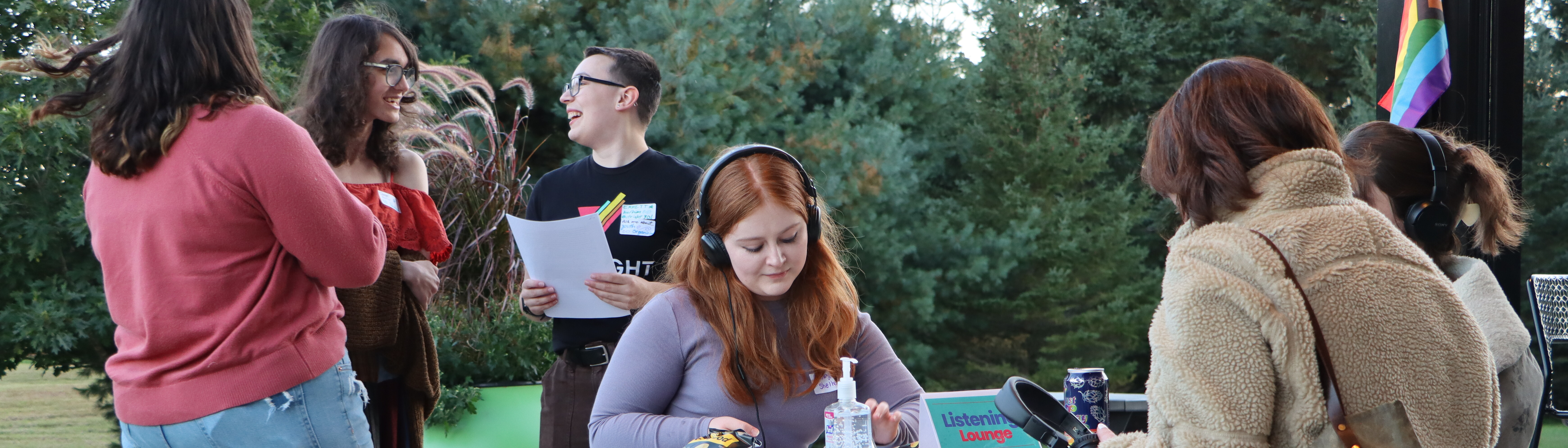
The best way to enjoy Transmission of Truth is together!
Episode Screening • Live Q&A Talk-Back • Free Pizza & Community
Transmission of Truth is a youth-led podcast about the lived experiences of transgender Vermonters.
For too long, trans people - especially youth - have been discussed, debated, legislated, and misunderstood, while their own voices and stories are missing and erased.
Through insight from experts and stories from the hearts of everyday Vermonters, Transmission of Truth offers a window into the lived experiences of the trans community, and the broader issues that impact their daily lives.
Episode 1: Policy is now live. Find it here, or wherever you listen to podcasts!
Episode 2: Family will be released Thursday, November 5, 2026.
Episode 3: Gender Affirming Healthcare will be released Thursday, January 7, 2027.
A special thank you to The Ally Coalition for their support to make Transmission of Truth a reality!

To celebrate the release of the first episode, we're throwing a Podcast, Policy, and Pizza Party!
The best way to listen to Transmission of Truth is in community. Come listen with us!
Join us to listen to the Policy episode together, and be part of a lively Q&A talk-back with creators and guests who appear in the episode! Pizza, including vegan options, is on us.
Here are all the details:
Wednesday, October 28, 2026 | 6 - 8 pm
All ages and identities welcome
Free, and pizza is provided
At Outright Vermont: 241 N Winooski Ave, Burlington VT
Space is limited - RSVP here by Monday, October 26 to save your spot!
For young trans Vermonters, policy is about so much more than stuffy courtrooms and civil duty. It’s a major player in every aspect of their lives - and it’s a matter of life and death importance.
In this episode, we hear from a legislator, a lobbyist, and a young trans advocate. We explore the policy landscape transgender Vermonters are navigating, how it affects all of us, and how all of us play a role in securing a better future for our state.
Opportunities for youth leadership: Outright Vermont and Education Justice Coalition of Vermont
Up-to-date information about policy affecting trans people: Trans Legislation Tracker and Movement Advancement Project
Other links and resources: Learn more about Proposition 4 and get involved in Narratives for Change
Transmission of Truth is produced by Outright Vermont Youth Organizers. Outright's mission is to build a Vermont where LGBTQ+ youth have hope, equity, and power.
This show is made possible with support from the Ally Coalition: providing critical support for grassroots nonprofit organizations bettering the lives of LGBTQ youth.
Ace: I would go to report things and, I would be told that they wouldn't do an investigation because it wasn't harassment. They wouldn't follow up, they wouldn't do anything because the law doesn't encompass bullying in the same way as it does harassment and hazing. And so if they can write it off as bullying, they will so they won't have to do anything about it.
Rafaela: I'm Rafaela, and you're listening to Transmission of Truth, a youth-led podcast about the lived experiences of transgender Vermonters, supported by Outright Vermont. Today's episode: policy.
Okay, stay with me here. I know that a lot of people hear policy and think: confusing legal-ese, endless bureaucracy, civil duty, blah, blah, blah. But as a certified policy nerd, I am here to tell you policy is so much more than all of that.
To explain why I care so much about it, I want you to meet Ace. They are 15 years old and a Youth Organizer with the Education Justice Coalition of Vermont, or EdJCo. Ace has worked on policy at multiple levels, ranging from their school to the Vermont State House, and their specialty is HHB, or Hazing, Harassment, and Bullying policy.
Ace: I had a really terrible middle school experience and dealt with HHB and the issues with the policy firsthand. And I don't want anybody else to have that experience.
Rafaela: The gaps in Vermont's HHB policy have had a direct impact on Ace's life and the lives of their friends.
Ace: There's so many LGBTQ people being targeted specifically. It can be very difficult to have so many people telling you that you shouldn't exist and that you're somehow wrong. I remember, like in middle school, I would be scared to go to school every day. I would be worried something was gonna happen to me. I was worried about my friends. And I really just wish people understood that it's not like something you can just brush off. It's not something you can just ignore, because it really is unsafe there's often threats and there's sometimes violence.
Rafaela: Ace didn't want anyone else to go through what they went through, so they joined the Education Justice Coalition as a youth organizer.
Youth organizers at Outright Vermont and EdJCo learn and work together to effect positive change across the state. In the program, Ace learned new frameworks to better understand and explain the harm they were experiencing, such as restorative justice and minority stress theory. These new ways of thinking about harm and repair shifted the way Ace viewed hazing, harassment, and bullying and made them realize the flaws in our system.
They also learned how to use their voice to make change: not just reporting harm to their school, but changing the processes their school used to respond to those reports. One of the avenues youth organizers use to speak out and make change is Outright Vermont's Youth Leadership Day at the Vermont State House, where they can testify in committees, interact with legislators, and share their perspectives at press conferences. This past spring at Leadership Day, Ace gave some incredibly powerful testimony on their experience with HHB policy as a trans student in Vermont.
Ace: Minority groups are targeted more. It was very important for me, in my testimony I mentioned my identity and that I am disabled and I am trans. I point those things out because, I think a lot of the time they do not realize that if you are in these groups you're more likely to be targeted. There was that gap of understanding of what it means, to be targeted for who you are and how common that is. They all acknowledged as soon as I said my testimony that it was a problem, and were asking questions to solve the problem. As soon as I finished speaking, they were already trying to do something, even just by asking me those questions. Something I've learned from having reported so many things so many times is that sometimes teachers just aren't aware. And so if the teachers in the school aren't aware, how can our lawmakers be if we're not telling them? I think it's very important that students are the one testifying because it's happening to you, you've seen it firsthand.
Rafaela: When Ace talks about the gaps in Vermont's HHB policy, they are naming something real. The truth is that the people writing and revising the laws that shape our schools, our senators and representatives, are constantly changing. New lawmakers come in, priorities shift, and education policy gets rewritten by people who are not living the day-to-day reality of our classrooms. Too often, they are not hearing it directly from the students those policies are supposed to protect. If we want our systems to work, not only our schools, but our roads, hospitals, social services, and more, all of us need to have our voices heard, and that means young people need to be a part of the conversation, not just the subject.
Ace: No student is going to deny that bullying and harassment are happening, whereas there are, I think, several, teachers and administrators who might fully with all their heart believe that it's just not a problem. Making sure that the person testifying is the person who's experienced it is so important.
Rafaela: The level of risk that trans youth like Ace are exposed to each day is heavily impacted by policy at multiple levels. Decisions that affect them are made at school board meetings, in the State House, and in the White House.
Ace: It's a very scary time right now. I think personally I'm so grateful to be in Vermont because, you know, I'm seeing these things happening in all of those other states are, like, popping up with these rulings, these crazy things. And I think there's plenty of that in Vermont too, but I think Vermont is one of the safest places you can be as a queer person right now. So I'm very grateful that I'm already here.
Rafaela: Policy doesn't exist in a vacuum. It directly impacts the everyday lives of Vermonters like Ace, you, and me. So to get a sense of what the policy landscape is like for transgender Vermonters, we spoke to one of the most consistent advocates for LGBTQ+ youth in our state, and one of the people in the State House working tirelessly to make sure that all Vermonters are fairly represented: Senator Ruth Hardy.
Senator Ruth Hardy: Vermont has a great? and strong tradition of protecting queer folks. We are a state that has been proactive in our protection of transgender individuals, and we have legislators and leaders who prioritize it. And there's still more work to do. It's not a perfect thing. We have a lot more work to do. Especially in this era where we have a federal government that's actively harming transgender people in our country.
Rafaela: Senator Hardy represents Addison County in the Vermont Legislature. She has played a leading role in strengthening protections for transgender and non-binary Vermonters, including sponsoring legislation that reaffirms access to gender-affirming care and reinforces Vermont's commitment to dignity and safety for all students. Senator Hardy is someone who listens closely to young people, takes their experiences seriously, and works to make sure our laws reflect the realities students face in their schools and communities.
Sen. Hardy: It's really important to me to make sure that trans youth know that I have their back. I have marched in a bunch of local Pride parades carrying a sign that says "This mom and senator has your back." And that's really how I feel, like I will be there for them, and I will make sure that their voices are heard and their rights are protected. And that's what I want them to know from me and from their government. And I think we do a decent job in Vermont, but there's more work to do, and I want them to know that I'm here to do that work.
Rafaela: Here in Vermont, we have a strong reputation when it comes to protecting the rights of LGBTQ+ people. The Movement Advancement Project tracks LGBTQ-related laws and policies in every US state and territory, And on its policy maps, Vermont is consistently in the highest-scoring category.
As early as the 1990s, Vermont began updating its state statutes to use gender-neutral language, an early recognition that our laws should reflect people of all genders. The state of Vermont was an early adopter of hate crime legislation that explicitly named sexual orientation as a protected identity from the get-go. We passed the nation's first law recognizing same-sex civil unions in the spring of 2000, and then in 2009 became the first state to legalize same-sex marriage through legislation rather than through litigation.
Over the past several decades, Vermont has built one of the strongest sets of protections for transgender people in the country, explicitly naming gender identity as a protected category across all of our major civil rights laws.
Sen. Hardy: Access to housing, access to education, access to healthcare. When we are talking about making sure that we're protecting access we can't discriminate based on sexuality, on race, on ethnicity.
Rafaela: These protections cover housing, education, healthcare, and public accommodations, meaning discrimination against transgender Vermonters is explicitly prohibited.
Today, trans Vermonters can update the gender marker on their birth certificates, driver's licenses, and marriage licenses, ensuring that their documents match who they are. Some other states require medical documentation or a court order for these changes, or simply ban them altogether, leaving trans people with misaligned identity documents that can expose them to discrimination and create barriers to housing, employment, and more.
In recent years, Vermont strengthened access to gender-affirming healthcare. After the Supreme Court overturned Roe v. Wade and federal protections were rolled back, Senator Hardy worked to pass two major healthcare shield bills, now known as Act 14 and Act 15.
Sen. Hardy: The federal government has now told hospitals that they will remove federal funding from hospitals if they provide gender-affirming healthcare to youth. We are actively seeking ways to still be able to receive federal funding because our state is very dependent on federal funding. But we wanna make sure that trans youth in Vermont can get the healthcare that they need. We wanted to make sure that in Vermont, people who were both providing this care and also accessing or seeking this care were protected. And so we passed these two bills that focus both on access to healthcare and also protections under the law.
Rafaela: These laws ensure that doctors cannot lose their licenses for offering gender-affirming care or abortion care, and that people seeking this care in Vermont are legally protected.
And now Senator Hardy is working on even stronger protections.
Sen. Hardy: We, in the last two legislative sessions, have done the work to pass an equal rights amendment to our Vermont Constitution. Vermont has one of the longest processes to amend our Constitution. It takes four years and two legislative biennia to pass an amendment in the legislature. And we have done that for this equal rights amendment that provides equal protection based on a whole slew of protected classes.
Rafaela: The amendment adds broad equal protection language covering gender, sexuality, race, disability, religion, and more, explicitly protecting transgender Vermonters at the constitutional level. Protecting equality in our Constitution makes our anti-discrimination laws more forceful, and importantly, more permanent.
Our current anti-discrimination laws could be rolled back with one vote. If Vermont passes Proposal Four, no matter who the next governor is or which legislation is passed at the State House, the rights of marginalized groups will be written into our foundational legal document.
Sen. Hardy: This November, Vermonters will get to vote on this constitutional amendment and have it included in the Vermont Constitution. So it will be on your ballot, and I just really encourage everybody to make sure you get out and vote for this equal rights amendment. It is incredibly important, and again, one of the ways that we lead in Vermont in protecting the human rights of the people who live in Vermont.
Rafaela: Voting on this amendment will be a historic moment. And it comes at a time when the stakes could not be clearer. The importance of the amendment was further highlighted by the pushback it faced on the floor. Earlier this year, Senator Steve Heffernan, who represents Addison County alongside Senator Hardy, made some degrading and transphobic remarks on the Senate floor. His comments were quickly condemned by lawmakers across the political spectrum for being dehumanizing and harmful. Moments like this remind us that even in a state with strong protections, transphobia shows up in our institutions, in our debates, and in the rhetoric used by people who hold power.
And Vermont is not isolated from what's happening nationally. Across the United States, transgender people are facing an unprecedented wave of legislative attacks. In twenty twenty-six alone, more than eight hundred anti-trans bills have been introduced in over forty states, with proposals targeting nearly every part of trans people's lives. In just a few years, the number of anti-trans bills has grown from dozens to over a thousand annually.
In this hostile political environment, Senator Hardy sees real value in being vocal about supporting marginalized groups.
Sen. Hardy: JRS 15 was a resolution that I introduced in the beginning of the second Trump administration and him coming out on his first day and declaring war on transgender folks in the United States.
Rafaela: JRS 15 is a declaration of Vermont's commitment to supporting our transgender and non-binary community and fighting discrimination. It passed unanimously. Senator Hardy lobbied hard for it because she knew Vermonters urgently needed a counterpoint to the harmful transphobic messaging coming from the federal government.
Sen. Hardy: This kind of rhetoric and the policies that are created because of it are dangerous. They are dangerous to the health and wellbeing and frankly the lives of transgender people, especially young transgender people in our country. They are creating violence against transgender people including the murder of transgender people and also to the mental health and wellbeing of transgender people. In our community alone in the last year we've had two young transgender people die by suicide and- as a mom, it just makes me so sad and scared for young people and what they're going through right now.
We have to do everything we can to support them and show up as leaders and make sure that they understand that we're here for them, and we have to follow up with legislation that supports and protects them.
Rafaela: Senator Hardy was clear that when it comes to protecting transgender youth, Vermont's work is far from finished. And while she and her fellow lawmakers have the positional power to pass legal protections, trans youth themselves aren't taking a back seat. Youth like Ace are on the cutting edge of creating Vermont's future policy landscape. Their power comes not from any official title or position, but from organizing together.
Ace: The more you speak up and the more you find more people and talk to more people with the same experiences, the more likely it is for the policy to change. I think that's why Leadership Day was so powerful, is because it brought so many people together. It wasn't just me testifying, it was so many youth brought together to testify. It takes a village. I think that's really important, especially in Vermont. Vermont is very community-based. But I think it's sometimes very easy to forget that people have your back on this side of things too, not just like, in your school or in your job, getting academic things done. They have your back in everything.
Rafaela: Another example Ace shared of how they've participated in collective organizing is Narratives for Change, an ongoing campaign created by a coalition of Vermont organizations. Narratives for Change began as a response to the Agency of Education announcing last spring that it was updating its HHB model policy without any plan for ensuring students' perspectives would be represented in the process. The coalition first successfully advocated for an extended timeline to the revision process. Now, they're using this time to speak out and lift up impacted voices. Through Narratives for Change, students who have been impacted by hazing, harassment, and bullying can share their stories to inform new policy recommendations that better meet their real needs and more effectively address harm.
Ace: The six demands from Narratives for Change, those are the things that we as a group decided to focus on. Having teachers who know what to do and students who are aware that they can report and there is a system that's meant to help them. Have there be an investigation when anything is reported.
Rafaela: The six demands ACE refers to are restorative justice, staff prevention training, youth training, mandatory intervention bullying policy, whistleblower protection, and transparency in communication.
Ace: Having the reporting process be as safe and comfortable as possible. Safety is always my number one priority.
Rafaela: Trans youth are the experts on their own lives, with unique insights and experiences to lead change. And as hostility towards the trans community is growing nationwide and rearing its head here in our state, it's both more risky and more crucial for trans youth to make themselves heard in the halls of power.
To help us navigate the State House during a moment when national attacks on trans people are rising at a historic pace, Outright has worked closely over the past year with Action Circles, an ethical lobbying and legislative strategy organization. Meg is a lobbyist with Action Circles.
Meg: We are not immune to the national polarization that is going on, and it's really sad and scary to see across the country, of course. We should not shy away from the fact that we are living in scary times. We are facing a hostile and authoritarian federal government that is trying to take away people's rights. I just wanna say that clearly and directly. I'm mostly proud of our state response. We are holding our ground as best we can against a very, very hostile and authoritarian government. And, it's really important for everyone to remain hopeful and to do the work that is needed to hold that ground.
Rafaela: Action Circles is known for something rare in politics: centering community, transparency, and youth leadership. When working with Outright, Meg doesn't speak for young people. She builds the pathways that allow young people to speak for ourselves.
Meg: I often think of my role as a liaison between organizations and the State House. So for Outright, that looks a lot like identifying opportunities where the youth that are involved in Outright can show up and speak on their own behalf. I know that there is a big eagerness among youth to share their own stories, and that's exactly what we wanna foster.
Cultivating leadership among young people in the political space is so exciting to me, and one of the most important things I think we could be doing. There's so many issues in the State House that affect youth.
Rafaela: When Ace was preparing to testify at the State House, Meg was there to help them strengthen their testimony and understand what to expect.
Ace: I think as a youth it's really hard to be heard by policymakers. And even if you're speaking up, sometimes they don't listen. And so I think that's really the key thing that Outright and EdJCo have both done for me, is give me the space to speak, and make people listen, and bring their attention to me. Because I have all the experiences, but sometimes adults won't listen to you unless you have an adult on your side. So yeah, it's, I think it's so important to have EdJCo and Outright supporting all of these youth.
Working with these adults who really understand the policy and can help with ideas and really understand it on a deeper level than I do really is helpful and gives me a lot of hope.
Rafaela: Meg also brought up something that doesn't always make it into conversations about policy: how inaccessible the State House can feel for young people and anyone from a marginalized community. The State House runs on norms like formal dress, rigid structures, and strict committee procedures. These explicit or unspoken rules can be tough to understand, and certainly weren't designed with youth, queer people, immigrants, or people of color in mind. For many, walking into that space doesn't feel neutral. It feels intimidating and alienating.
Meg: The system that we're working in was not really designed to be sensitive to a very diverse range of backgrounds and people and experiences. So we are always working to dismantle that in our work. How do we honor the flexibility that is needed for youth to show up with sort of the lack of flexibility in, that exists in the State House?
Rafaela: Meg is constantly trying to bridge the gap between the structure of the State House and the lived realities of the people most affected by policy. She thinks about how to make testimony safer, how to make the environment more welcoming, and how to dismantle barriers so more people can show up, speak, and be taken seriously.
Meg: So It's not enough to just say "Hey, who wants to testify in this committee?" We also need to do the work to translate really complex legal jargon into plain language so that everyone knows what a bill does, and then also help support the writing of that testimony. And even things like state house etiquette which is a huge piece and sometimes feels weird to talk about because that's, like we don't ever want to tell anyone how they have to show up in a space, right? At the same time, they're trying to deal with a million issues a day, and they might have five minutes for testimony, and that doesn't really feel good for a lot of people that have to sort of work up the courage and get ready to show up in such a space.
Rafaela: Ace also brought this point up from a place of personal experience. When the systems aren't designed with you in mind, it feels even harder and riskier to speak up and make a change.
Ace: I think it's very easy to feel alone. 'Cause It's not always safe as a trans person to speak out . It's so important to have those who are safe in doing so to come forward and speak.
Rafaela: Alone, it's difficult to make real change, but when we recognize the value of marginalized voices, we can build systems that allow everyone to be heard, and the result is a fairer, safer, and more vibrant Vermont.
Meg: As we move forward, I'd love a more intentional system where with any given policy issue, if we know that it's going to affect youth and especially trans youth, scheduling that testimony should be one of the first steps that committees are taking. It's often overlooked. And in our system, it's standard to hear from state agencies first.
Rafaela: And when more impacted people are able to give testimony and be heard, that creates a ripple effect - because testimony is a crucial source of perspective and understanding for decision makers like Senator Hardy. When she's drafting laws and casting votes, she reflects on the voices and stories of everyday Vermonters.
Sen. Hardy: I make a lot of effort to talk with transgender folks in my district and around the state and make sure that I'm understanding their perspective and their needs and not making assumptions. And I learn a lot that way as a senator, as a legislator, as a policymaker, as a public servant just about personal experiences. I think it's really important making sure that they are invited to testify, making sure they have a voice in the State House and in our communities.
Rafaela: Vermont is a national leader in promoting safety and inclusion for trans people. And as the national landscape becomes increasingly hostile, Meg sees that Vermonters have an opportunity - and a responsibility - to stand up for what's right and keep our communities safe and strong.
Meg: Here in Vermont, we protect our neighbors, we protect the people we know in our community, no matter who they are. It's on all of us to continue to interact with community and build community and not shy away from this. We are facing serious threats. We don't wanna downplay that, and we have the community in Vermont to face that head on.
Rafaela: Meanwhile, decision makers like Senator Hardy in the State House are called to show courage and conviction, and they're taking their cues from everyday Vermonters like us.
Sen. Hardy: What gives me hope is people who are on the front lines fighting for the rights of transgender people and queer people in Vermont. There's just so many amazing youth advocates and youth activists and also just young people living their their true lives, living their identity in a way that they feel confident and secure and happy, and saying, "Look, I'm a happy healthy individual, and that's part of my resistance," and I think that's amazing. And we have some amazing leaders in our state that are working really hard to protect the rights of transgender people and that gives me hope. And I think we all have to focus on the things that give us hope, especially in these somewhat dark times. So thank you for the work that you do and… yeah, you give me hope.
Rafaela: And for our part, LGBTQ+ youth leaders are clear. We're not backing down.
Ace: I want to share with other queer and trans people that it's okay that this feels unsafe right now, and that's totally valid. It's okay to feel unsafe. It's okay to seek support. And if you are able, it's so important to speak up because we really need as many voices as possible in this fight. I never understood for a very long time that you don't have to vote to change policy. You can speak to the people in positions of power, and you can write letters, and you can testify. When I was younger, I was always like, "Oh, there's something wrong with these policies, but what can I do about it?" And so I think it's really given me the power and let me know that I've always had this power to make these changes.
End Credits: If you enjoyed this show, please follow and share it with a friend. And if you have questions or feedback about today's episode, email us at info@outrightvt.org or find us on social media at @outrightvermont. We'd love to hear from you.
Transmission of Truth is produced by Outright Vermont Youth Organizers: ?Annabella Ferrier, Emmett Wiggins, Chloe Mol, and me, Rafaela Botti.
Our work is supported by Outright Vermont. Outright's mission is to build a Vermont where LGBTQ+ youth have hope, equity, and power. Learn more and get involved at outrightvt.org.
This show is made possible with support from the Ally Coalition. Through tours, campaigns, events, and partnerships, the Ally Coalition provides critical support for grassroots nonprofit organizations bettering the lives of LGBTQ youth. Learn more about them at theallycoalition.org.
Thank you for listening, and we'll see you next time!
Welcome to Transmission of Truth, a youth-led podcast about the lived experiences of transgender Vermonters. In each episode, we explore a system or area of life where transgender Vermonters have a unique stake.
"Today's episode:"
"Policy."
"Family."
"Gender-affirming healthcare."
Along the way, we get to hear insight from experts and stories from the hearts of everyday Vermonters.
"I mean, the first thing we did was tell her that we love her, you know? We said, whatever's going on, we're here. We love you. We wanna know more."
"Since starting medical transition, at first I got this feeling of euphoria, but pretty quickly that gave way to something sort of better, which was just feeling okay."
It's a way to see our state and our neighbors through fresh eyes.
"We are a state that has been proactive in our protection of transgender individuals, and we have legislators and leaders who prioritize it. And there's still more work to do."
And it's a window into a community defined by authenticity, hope, and resilience.
"It is never too late to start. I think there will be people there for you, regardless of how long it takes for you to get to where you wanna be."
"I've always had this power to make these changes."
Find Transmission of Truth wherever you get your podcasts.

Get to know the awesome Youth Organizers behind Transmission of Truth!
RSS | Spotify | iHeartRadio | Amazon Music | Youtube | Pandora | Apple Podcasts
Wednesday, October 28, 2026 | 6:00 - 8:00 pm | At Outright
Come celebrate our NEW youth-led podcast, Transmission of Truth!
Episode Screening • Live Q&A Talk-Back • Free Pizza & Community
Sign up for our weekly newsletter!